Le Dispositif de Déploiement Automatique : Une technologie spécifique au parachutisme, au service de la sécurité!
Temps de lecture estimé: 14 minutes
L’une des questions les plus souvent posée quand on parle de saut en parachute est la suivante: Est-ce que la voilure du parachute peut s’ouvrir toute seule? La réponse est oui, absolument! En fait, chez Parachute Voltige, excepté pour certaines disciplines sportives spécifiques, ce qu’on appelle le Dispositif de déploiement automatique (DDA, pour les intimes) est obligatoire sur tous les équipements, incluant les équipements tandems.
Comment ça marche au juste un dispositif de déploiement automatique de parachute?
 À travers le temps, l’équipement utilisé par les parachutistes pour se lancer d’un avion en vol à des milliers de pieds d’altitude a beaucoup évolué, au grand plaisir de tous! La technologie a ainsi aidé à améliorer des aspects de sécurité liés à la pratique du parachutisme. C’est le cas notamment du Dispositif de déploiement automatique (DDA), aussi appelé Dispositif d’activation automatique (DAA).
Ce dernier est un petit ordinateur dissimulé dans l’équipement qui va déployer automatiquement le parachute de secours (d’où son nom) s’il constate que le parachutiste se déplace encore à grande vitesse, donc en chute libre et ce, à une altitude plus basse que prévue.
Cela pourrait survenir si un sauteur perd conscience, s’il a une malfonction avec son parachute principal ou si son altimètre est déréglé, par exemple.
Ceci dit, il est de la responsabilité de chaque parachutiste sportif ou instructeur tandem de procéder à une vérification de son équipement avant de l’endosser et de s’assurer que le DDA est bien opérationnel. Chez Voltige, nous procédons à cette vérification à chaque début de journée, PUIS AVANT CHAQUE SAUT!
Quelques points techniques!
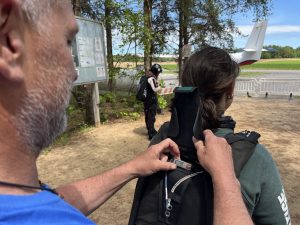
De manière plus précise, comment fonctionne-t-il? Eh bien le module électronique de l’appareil est accessible au parachutiste pour que ce dernier puisse l’allumer, l’éteindre ou vérifier qu’il soit en fonction. Ce module ressemble généralement à un petit écran de quelques centimètres à peine et fait sur le long. Un bouton se trouve à côté de l’écran pour l’opérer.
Un câble, relié à ce module de commande, se faufile à l’intérieur du sac à dos du parachute jusqu’à la voilure de secours. Au bout du câble se trouve un autre module électronique, dissimulant une petite lame. Dans l’éventualité où un parachutiste n’aurait pas ouvert son parachute principal à une certaine altitude, le module électronique déclencherait la lame qui couperait la boucle qui tient fermé le parachute de secours. C’est comme une micro-guillotine ou un coupe-cigare, mais dont la victime serait la boucle de fermeture!
Comment le module électronique fait-il pour savoir à quelle altitude déclencher sa guillotine?
D’abord, quand le sauteur allume son DDA, il est important de le faire au sol, à l’endroit où il prévoit atterrir. Le dispositif prend alors ce point de référence comme ground zero. Une fois dans l’avion, jusqu’à l’altitude de sortie, le DDA prend en compte le changement de pression atmosphérique. C’est comme ça qu’il calcule la distance du sol qui est en train de se créer. Une fois sortie de l’avion, alors que le parachutiste est en chute libre, le DDA peut constater s’il tombe encore à haute vitesse, alors qu’il a dépassé l’altitude à laquelle il avait prévu ouvrir le parachute principal. Le DDA prendra alors en charge de déployer le parachute de réserve!
Un peu de physique 101!
Disons que la zone d’atterrissage et l’aéroport se trouvent dans des lieux éloignés l’un de l’autre, comme c’est le cas dans certaines écoles de parachutisme à l’étranger. Si le sauteur allume son DDA à l’altitude de l’aéroport et que cette dernière diffère de l’altitude où il va atterrir son parachute, cela pourrait altérer les mesures sur lesquelles se base le DDA pour fonctionner correctement.
Par exemple, si l’aéroport se trouve quelques centaines de pieds plus haut que la zone d’atterrissage et que le sauteur allume le dispositif à l’aéroport, celui-ci risque de se déclencher inutilement trop tôt. La lame se déclenchera quelques centaines de pieds plus haut que prévu puisqu’elle aura pris en compte la mesure de base initiale de l’aéroport.
À l’inverse, si l’aéroport est quelques centaines de pieds plus bas que la zone d’atterrissage, une erreur du genre pourrait être fatale pour le parachutiste. Le DDA ne considérerait pas être encore à l’altitude préprogrammée et n’actionnerait pas la petite guillotine au moment voulu. Soyez sans crainte: la zone d’atterrissage de Voltige et notre piste de décollage se trouvent à quelques mètres l’une de l’autre et sont donc à la même altitude!
Il est important de garder en tête qu’un Dispositif de déploiement automatique est un appareil électronique. Nul n’est à l’abri d’une défaillance. Cependant, en 30 ans, il a permis d’éviter plus de 5 100 accidents[1], faisant ainsi du parachutisme un sport sécuritaire! Gardez en tête qu’en plus des outils techniques que la science nous a offerts pour pratiquer ce beau sport, c’est la grande expérience des parachutistes et des instructeurs tandems qui fait toute la différence. Nous sommes plus qu’heureux de mettre plus de 20 ans d’expérience précieuse à votre service, pour vous faire vivre le moment le plus marquant de votre vie!
Un texte écrit par François Bertrand-Potvin
[1] Airtec Verwaltungs GmbH, CYPRES, https://www.cypres.aero/about/the-story-of-cypres-2021/#:~:text=saved%20more%20than%205%2C100%20lives